
Feedback or Fallout? How Conscious Leaders Keep Collaboration Intact While Speaking Up
Let’s be honest: Feedback is one of those words that makes people either brace… or bolt.
And yet—nothing meaningful happens without it.
In fact, feedback—when done right—isn’t confrontation. It’s contribution.
But here’s the catch:
Collaboration doesn’t crumble from feedback.
It crumbles from how that feedback is delivered.
Because the art of collaboration is really the art of communication.
And communication that builds rather than breaks requires intention, context, and yes… reflection.
TABLE OF CONTENTS
The First Check: Is It You?
How to Deliver Feedback Without Burning the Bridge
1. Feedback to Team Member: Clarity > Critique
2. Feedback to Board Member: Tread Smart, Not Soft
3. Feedback to Business Partner: Expectations, Not Assumptions
What’s the Feedback Through-Line?
Ready to deepen your influence without damaging relationships?
The First Check: Is It You?
Before we go pointing fingers, pause.
That rising frustration? That urge to “just give them the truth”?
Start by asking:
 Am I reacting… or responding?
Feedback without self-check is projection in disguise.
So before you open your mouth, open this loop:
- Why does this issue need addressing?
Is it affecting outcomes—or just poking at your ego? - Is it a result of their behavior—or your boundaries (or lack thereof)?
- Are you prepared to be part of the solution—or just delivering the problem?
Because leadership isn’t about being right.
It’s about being responsible.
How to Deliver Feedback Without Burning the Bridge
Here’s a simple structure that works in just about any collaborative setting:
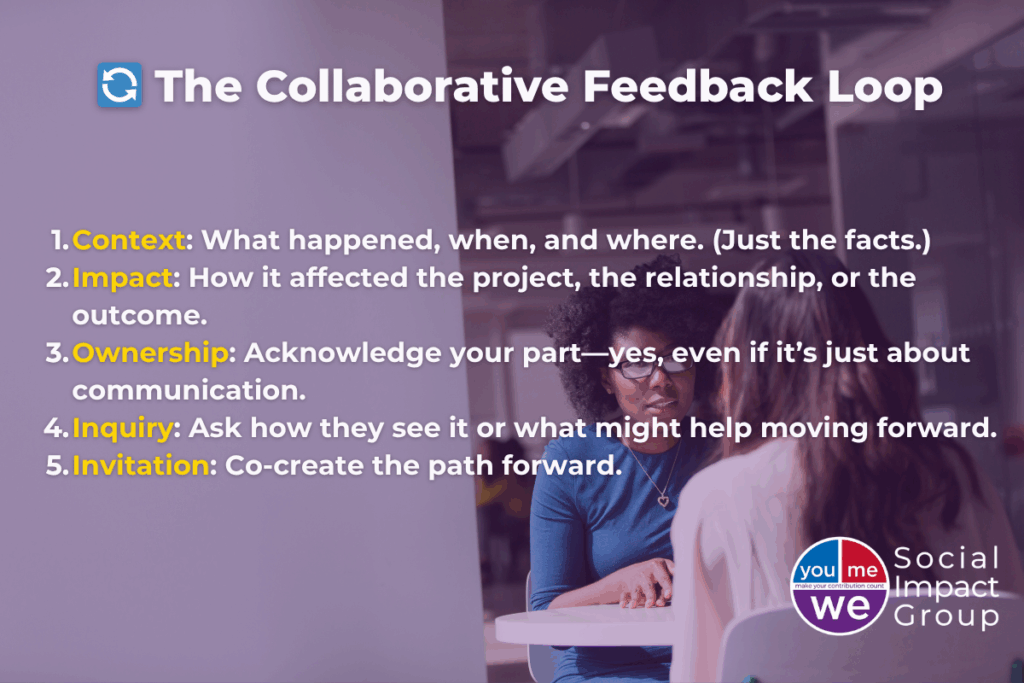
 The Collaborative Feedback Loop
- Context: What happened, when, and where. (Just the facts.)
- Impact: How it affected the project, the relationship, or the outcome.
- Ownership: Acknowledge your part—yes, even if it’s just about communication.
- Inquiry: Ask how they see it or what might help moving forward.
- Invitation: Co-create the path forward.
This isn’t a script—it’s a framework.
The power is in how you show up inside it.
Let’s say your team member missed a deadline… again.
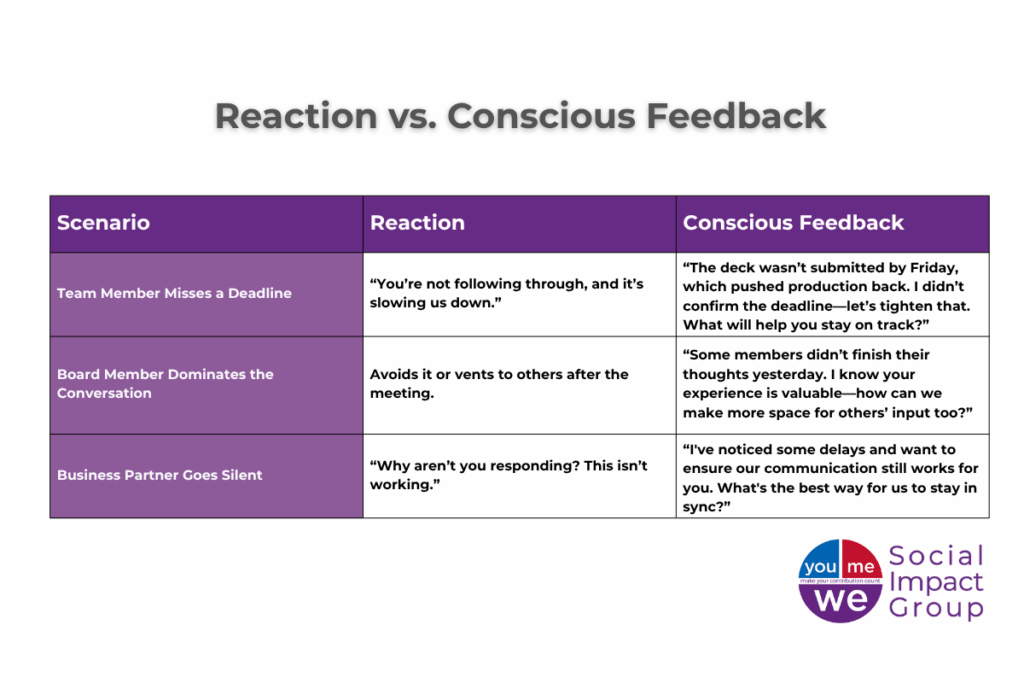
The reactive route?
 “You’re not following through, and it’s slowing us down.”
Oof. That’s a shutdown waiting to happen.
Try this instead:
“The deck wasn’t submitted by Friday, which pushed our production back a day. I realize I didn’t confirm the deadline in writing—so let’s tighten that up. What will help you stay on track moving forward?”
See what just happened?
You named the issue, took partial ownership, and created a collaborative next step.
Feedback isn’t about fault.
It’s about forward.
Boards are full of diverse personalities—and power dynamics.
Let’s say a board member monopolizes discussion, cutting others off mid-thought.
You could steam quietly and vent later.
Or… practice conscious leadership.
Try this:
“In yesterday’s meeting, a few members didn’t get to finish sharing their thoughts. I know your passion comes from experience, and I’d love to make sure we create space for more voices. Any ideas on how we can do that as a group?”
You acknowledge value and gently reflect impact—without calling out, shaming, or escalating.
In boardrooms, diplomacy isn’t weakness.
It’s wisdom.
Let’s say your partner hasn’t been getting back to you. The texts, the emails… crickets.
The frustrated leader might go in hot:
“Why aren’t you responding? This isn’t working.”
Yikes.
Instead, wave-make with curiosity and clarity:
“I’ve noticed some delays in our back-and-forth, and I want to make sure our communication still works for you. How do you prefer we stay in touch to keep things moving smoothly?”
It’s not just feedback—it’s feedback that invites ownership on both sides.
Because assuming creates gaps.
Clarifying closes them.
What’s the Feedback Through-Line?
Feedback doesn’t need to be fierce to be effective.
It doesn’t need to be loud to be heard.
It needs to be grounded in reflection.
Delivered with intention.
And wrapped in collaboration, not correction.
So before you give that feedback, ask yourself:
Are you speaking to elevate…
or just to unload?
One builds trust.
The other breaks it.
Collaboration without feedback is like steering a ship with no rudder. You may float for a while, but don’t be surprised when you drift off course.
Ready to deepen your influence without damaging relationships?
 Ready to influence with curiosity?
Download the 4C Framework of Influence and learn how to build trust, inspire action, and stay in the sweet spot between curiosity and overstep.4C Framework of Influence
Because conscious leaders don’t avoid tough conversations.
They lead them—bravely, and better
The post Feedback or Fallout? How Conscious Leaders Keep Collaboration Intact While Speaking Up appeared first on YouMeWe.
The article was originally posted by %author_name% Originally posted on%post_title%
. This article originally posted on Source
